Three days. More than 100 physicians. One shared goal: advancing the future of pain medicine.
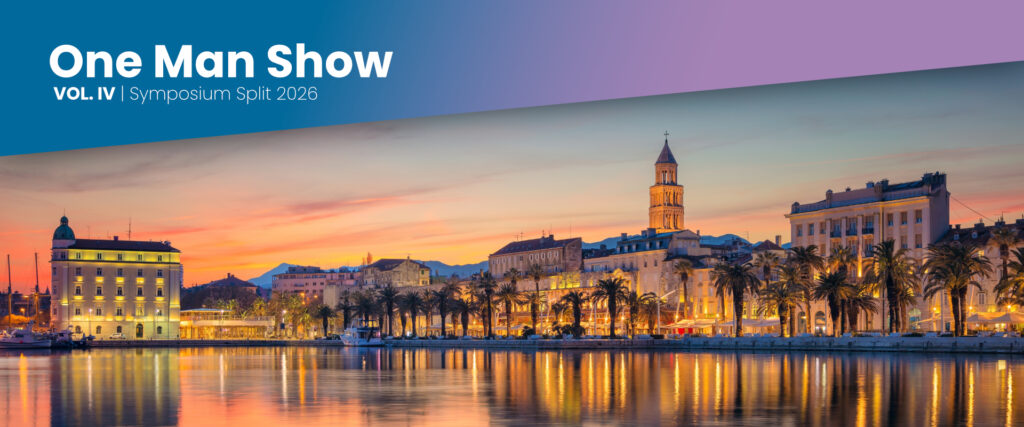
The fourth edition of the international medical symposium One Man Show Vol. IV, organized under the auspices of the Interventional Pain Academy by EuroPainClinics, took place from 18 to 20 May in Split, Croatia. The event welcomed more than one hundred participants from around the world.
The scientific program, centered on the theme “Exploring advanced pain therapies integrated with regenerative medicine approaches”, was delivered by nearly thirty faculty members actively contributing to the academic content. The main guest and keynote speaker was Dr. Teodor Goroszeniuk, President of The London Pain Forum.
More Than a Symposium: “A Vision of the Future”
Originally an internal educational initiative for EuroPainClinics physicians, One Man Show has evolved since 2023 into a unique international symposium. Today, it serves as a meeting point not only for our physicians but also for a global community of experts, researchers, educators, and visionaries.
All participants are united by a common goal: to push the boundaries of interventional pain management, regenerative therapies, and patient-centered care. Through intensive exchange of clinical experience, collaboration, and education, the symposium fosters the safe and effective development of modern evidence-based treatment approaches, ultimately contributing to improved patient care worldwide.
Beyond the scientific program, the true value of the symposium lies in its people—experienced clinicians, renowned researchers, educators, and innovators, as well as the emerging generation of young specialists. The exchange of knowledge and perspectives across disciplines and countries creates an environment that supports professional growth, collaboration, and continuous improvement in clinical outcomes.
Under the leadership of Robert Rapcan, MD, FIPP, MBA, PhD, founder of the Interventional Pain Academy and Chairman of the scientific faculty, leading experts from medicine and research once again gathered in one place. Their participation and willingness to share experience significantly enriched the scientific program and reinforced its international dimension.
This year’s program was designed at a new level. As Dr. Rapcan noted:
“I envisioned a concept different from standard symposia. Instead of traditional presentations, we focused on interactive discussions that address questions clinicians often do not ask, although they are highly relevant in everyday practice. The goal was to solve these issues—completely or at least partially. Thanks to outstanding speakers and a well-structured program, this aim was achieved beyond expectations.”

Scientific Program Supported by WIRM
The scientific program was supported by the World Institute of Regenerative Medicine (WIRM), whose founders Dr. Sudhir Diwan, Dr. Annu Navani, and Dr. Douglas Beall attended the symposium as active participants.
MUDr. Robert Rapcan is also a member of the institute’s scientific board and, starting January 2026, will serve as Chairman of the WIRM Chapter for Scandinavia, Southern and Central Europe.
The symposium opened with a formal welcome and introduction of all guests and faculty members, moderated by Dr. Rapčan.
The opening scientific session featured a presentation by EuroPainClinics IT specialist Tomas Jakab, titled “AI-Driven Interventional Pain Relief Clinic”. The lecture focused on the practical use of artificial intelligence in clinical practice, including system-level optimization, faster patient triage, documentation support, and improved safety monitoring in clinical workflows.
Day 1 – Inspiration from Clinical Practice
The first day was dedicated to the interactive session “Real Case Videos”, showcasing advanced endoscopic procedures and integrated regenerative treatment approaches in real clinical settings.
Participants viewed original case videos presented by MUDr. Robert Rapcan, Dr. Arletta Witkowska-Łuczak, Dr. Danielle Kohr, Dr. Agnes Stogicza, and Dr. Girish Datar, among others.
The presented techniques included nucleus augmentation, spinal cord stimulation, caudal epidurolysis using the Racz catheter, epiduroscopy, basivertebral nerve ablation, epiduroscopically assisted adhesiolysis, guided osteotomy procedures for decompression in spinal stenosis, and uniportal full-endoscopic foraminal decompression.
Additional procedures included the application of biologically active orthobiologics, particularly subchondral and intradiscal injection of bone marrow aspirate concentrate (BMAC), often combined with transforaminal endoscopic techniques, as well as endoscopic lumbar discectomy with BMAC application.
Day 2 – Endoscopic Approaches and Regenerative Medicine
The second day featured two extensive panel discussions.
The morning session, “Endoscopic Spine Procedures”, focused on minimally invasive spinal surgery. Leading experts—including Dr. Girish Datar, Dr. Douglas Beall, Dr. Didier Demesmin, Prof. Dr. Håkan Alfredson, Dr. Krzysztof Lokas, Dr. Michal Matias, Dr. José De Andrés, Dr. Amar Salti, Prof. Dr. Anagha Deshpande, and others—discussed practical aspects of spinal endoscopy.Topics included the role of needlescopy with the 7StarScope imaging system as both a diagnostic and therapeutic tool, indications for transforaminal versus interlaminar approaches, and scenarios in which endoscopic procedures may serve as an alternative to open spine surgery.The afternoon session, “Regenerative Medicine”, focused on the rapidly evolving field of orthobiologics in pain management.Experts such as Dr. Annu Navani, Dr. Sudhir Diwan, Dr. Dominic Hegarty, Dr. Ricardo Ruiz López, Dr. Arleta Witkowska-Łuczak, Dr. Manojit Sinha, Dr. Victor Fontes Pacheco, Dr. Dzihan Abazović, Dr. Leszek Urbańczak, and Dr. Agnes Stogicza discussed, among other topics, subchondral biologic delivery in Modic changes, the role of PRP and BMAC in osteoarthritis of large joints, and key criteria for implementing regenerative medicine as a first-line therapeutic option within integrated care pathways.
Day 3 – One Man Show: Dr. Teodor Goroszeniuk – “A Journey”

The final day began with the highly anticipated One Man Show by guest speaker Dr. Teodor Goroszeniuk, FCARCSI, FFPMCAI.
A global pioneer in neuromodulation for pain management, Dr. Goroszeniuk shared personal reflections and key experiences from his extensive clinical career, interwoven with selected personal stories that shaped his professional journey.
Dr. Goroszeniuk is President of the London Pain Forum, Co-Director of Remedius Limited, and a founding figure of the Interventional Section of the Polish Pain Society, where he served as its first president. He is also a co-founder and Vice President of the Polish Neuromodulation Society
Dr. Goroszeniuk practices interventional pain medicine and neuromodulation at Cromwell Hospital in London and has extensive experience within the UK National Health Service (NHS). He is a frequent international speaker and workshop leader in neuromodulation.
In his presentation, he highlighted key milestones in the development of electrical stimulation in medicine—from early clinical electrotherapy led by Dr. Golding Bird at Guy’s Hospital in London, through the first neuromodulation procedures in Poland in 1920, to modern spinal cord stimulation and peripheral nerve stimulation techniques used in chronic pain management.
Dr. Goroszeniuk concluded by presenting his vision for the future of neuromodulation, emphasizing its convergence with biomedicine and regenerative medicine approaches.


Neuromodulation – The Future Perspective
The afternoon panel “Neuromodulation” directly followed Dr. Goroszeniuk’s lecture and expanded on current clinical applications and future perspectives of neuromodulatory therapies.
The discussion included Prof. Dr. Leonardo Kapural, Dr. Danielle Kohr, Prof. Ashish Shetty, Dr. Peter S. Staats, Dr. Alaa Abd-Elsayed, Dr. Bartosz Czapski, and Dr. Miles Day.
Topics included neuromodulation for chronic abdominal and visceral pain, spinal cord stimulation for postherpetic neuralgia and trigeminal neuralgia, comparative positioning of neuromodulation versus other interventional techniques, ultrasound-guided pain interventions, and neuromodulation in oncologic pain management.


Education, Inspiration, and Shared Experience
The symposium successfully achieved—and in many aspects exceeded—its objectives. Feedback from participants confirmed the high scientific quality and the value of interdisciplinary exchange.
The meeting once again demonstrated that collaboration between leading experts from different countries leads to new clinical insights, improved treatment strategies, and continuous advancement in patient care.
Special thanks go to all faculty members for sharing their knowledge, experience, and innovative approaches, which served as a valuable source of inspiration and professional development.
The event was organized under the leadership of MUDr. Robert Rapcan, with full operational support from the organizing team: RNDr. Jakub Štofila, Lenka Kovaličová, Eva Manik, Matúš Gmitter, Bc. Ján Knapík, Tomáš Jakab and Ing. Ján Varhol.
The international symposium was made possible thanks to the support of Dynamic Medical Solution, EuroPainClinics, MaxMoreSpine Inc., Lumibird Medical, EPIMED, Metrum Cryoflex, Alieva, Medicinski Centar Split, Divota Apartment Hotel, and Vivere Adriatic.


